The Course
Bray Hill and the Start of a Lap
The first mile of a TT lap: the Grandstand start on Glencrutchery Road, the drop down Bray Hill, Quarter Bridge and the run out through Braddan.
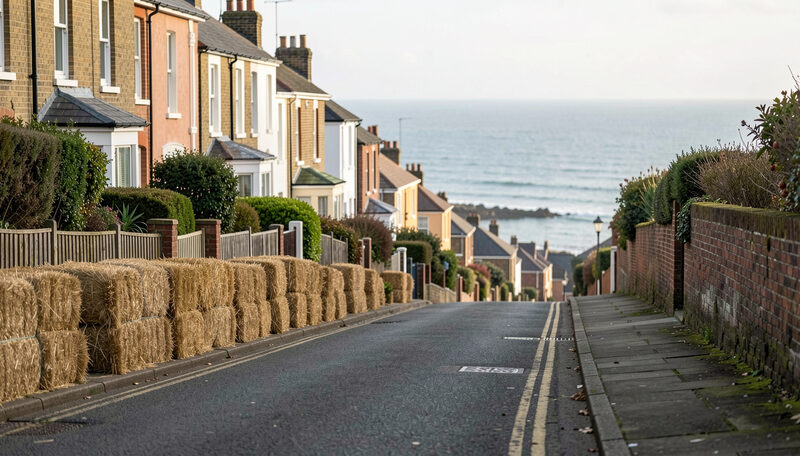
The first mile of a TT lap is the most crowded and the most deceptive. It begins on a flat, ordinary street in Douglas, drops down a hill steep enough to frighten a cyclist, turns hard at a bridge, and then runs out of town at speed. Riders talk about the start of a lap as a place to survive rather than a place to attack, because the tyres and brakes are cold and the walls are close. This guide follows the course from the Grandstand to the point where it leaves the capital.
The Grandstand and the start line
The course begins on Glencrutchery Road, beside the TT Grandstand, where the start line, the timing tower and the paddock sit within a few hundred metres of each other. On race day this is the busiest part of the circuit. Grandstands, a fan zone and the main spectator facilities are here, and the road ahead is visible from the stands as it falls away toward Bray Hill.
The start itself is a standing start for the first machine and then a stream of riders released at intervals, because the TT is run as a time trial rather than a mass-start race. That format is explained in the guide to the TT races. For a spectator, the practical effect is that the start line is a place of constant activity rather than a single moment.
Bray Hill
A few hundred metres after the line the road drops down Bray Hill, one of the steepest and most famous descents in motorcycle racing. The gradient is enough to unweight a machine, and the surface has a crown and a series of undulations that riders must read at speed. The corner is lined with houses, garden walls and lamp posts, and the crowd stands on both pavements, close enough to feel the air move as a rider passes.
Bray Hill is photographed more than almost anywhere else on the course, and it is also the place where the danger of road racing is most visible. There is no run-off. A rider who arrives too fast or too wide has only the street furniture and the walls. That is why the approach to the corner is treated with such care, and why a good start here is measured in survival rather than in tenths of a second.
Quarter Bridge
At the bottom of the hill the course turns right at Quarter Bridge, a slow corner where the road leaves the residential streets and crosses the river. The turn is tight enough to demand heavy braking from very high speed, and it is one of the places where a rider can lose a race without crashing. The exit leads onto the A1 road toward Peel, and the character of the circuit changes immediately from town streets to a wider country road.
Quarter Bridge is a good place to watch for a spectator who wants to see braking and body position rather than outright speed. The corner is also a natural dividing point on the course: everything before it is town, and everything after it is open road.
Braddan Bridge and the run out of Douglas
Past Quarter Bridge the course crosses Braddan Bridge, where a church stands beside the road and the crowd is traditionally dense. From there the route runs through Union Mills and out toward Glen Vine and Crosby. The bends come in a sequence, and the road is bordered by walls, hedges and the occasional building, so the sense of enclosure lasts longer than a first-time visitor expects.
This is the part of the lap where riders settle into rhythm. The opening mile is over, the tyres have some heat in them, and the course begins to reward smoothness. It is also the part where a spectator can move between several named corners on foot, because the villages sit close together along the same road.
What to watch for
Three things make this section worth a spectator's time. The first is the start line itself, where the machinery, the noise and the organisation of a race day are all visible at once. The second is Bray Hill, where the drop and the proximity of the crowd create the atmosphere the TT is known for. The third is Quarter Bridge, where the transition from town to country shows how quickly the course changes character.
A spectator planning a first visit can find practical detail on access and timing in the guide to where to watch the TT. A reader who wants the names of the corners in order can use the index of named corners of the Mountain Course, and a reader who wants the whole circuit in one view can start from the guide to the Snaefell Mountain Course.
Why the opening mile matters to the whole lap
A lap of the TT is a single continuous effort, and the opening mile sets its tone. A rider who loses time at Quarter Bridge will try to recover it over the next thirty-six miles, which means taking risks elsewhere. A rider who gets through the town cleanly can build speed gradually as the course opens out. That is why teams study the start as carefully as the mountain, and why the fastest lap on record, set by Peter Hickman in 2023 at an average of 136.358 mph, is as much a story about consistency through the town as about courage on the hills. The official figures are published by the organisers at iomttraces.com.
From here the course runs west toward Ballaugh Bridge and the villages of the north west, where the rhythm of the lap is built. The opening mile is only the first piece of a very long puzzle.